Retainer vs On-Demand Legal: What actually scales for Startups
Most startups don’t think about legal issues until something goes wrong.
A deal slows down.
A contract comes back with unexpected changes.
A compliance issue surfaces during fundraising.
At that moment, the question becomes urgent: “Do we need a lawyer on retainer, or should we just call someone when needed?”
It feels like a reasonable choice. In reality, it’s the wrong question.
The two models startups default to and why both disappoint
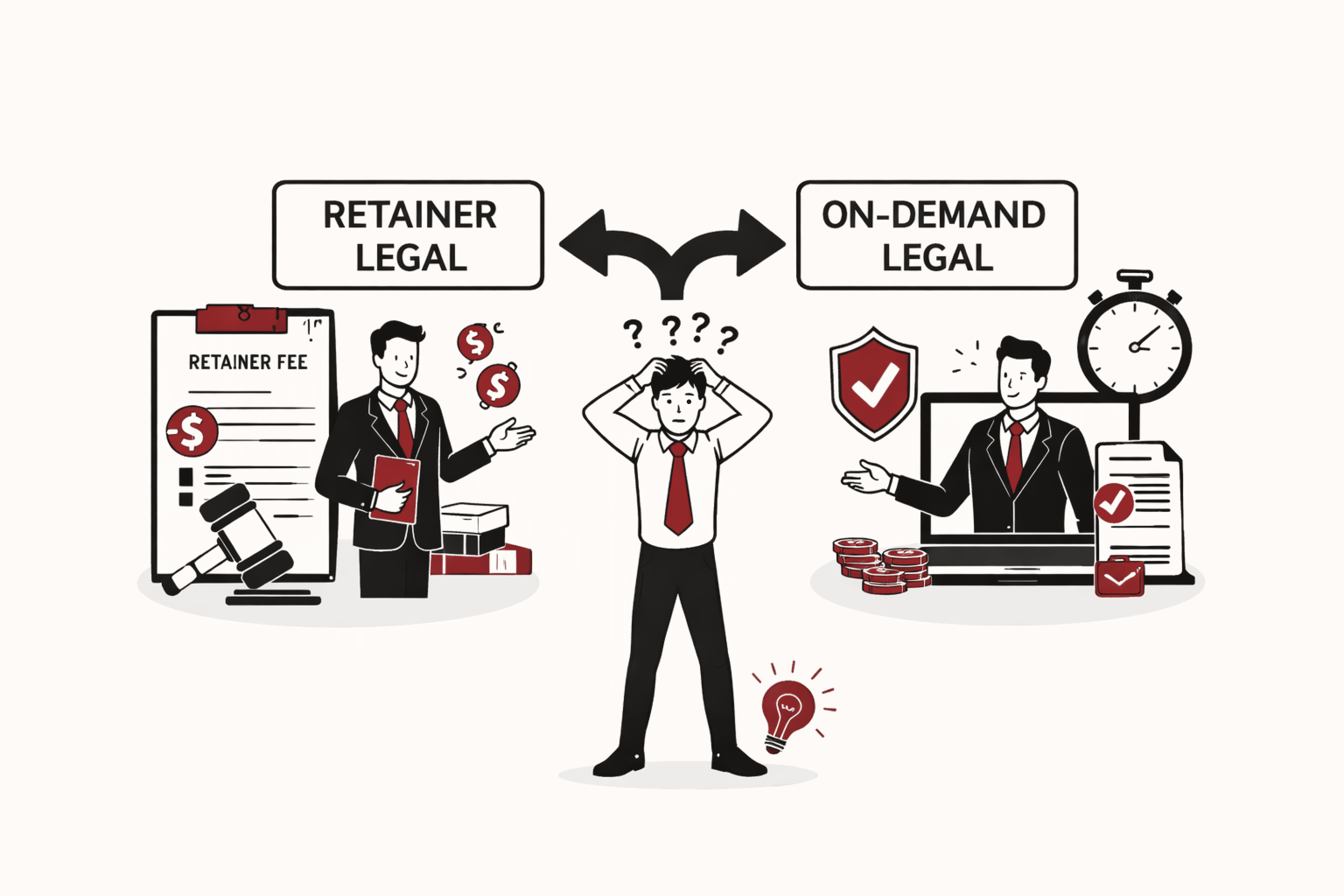
1. Expensive Law Firm Retainers: predictability on paper, friction in practice
Monthly retainers appeal because they promise control. A fixed fee. A familiar lawyer. Fewer surprises. They work well only when legal work is steady and repeatable.
Startups don’t work like that. Legal demand spikes unpredictably, sales pushes close together, partnerships stack up, diligence happens alongside day-to-day contracting. Retainers quickly run into scope limits, slow prioritisation, or silent trade-offs between speed and depth.
2. On-demand legal: flexibility that fragments context
On-demand legal feels efficient early on. You pay only when something comes up.
But as volume increases, every request becomes a fresh start:
New context
New standards
New turnaround expectations
Nothing compounds. Nothing improves over time. Costs swing wildly. Risk is reviewed late. Legal becomes reactive by design not because lawyers are slow, but because the system resets every time.
The real issue: legal doesn’t scale like headcount or spend
Both models fail for the same underlying reason: Legal work is treated as episodic. Contracts repeat. Risks repeat. Positions repeat. But the workflow is ever evolving.
Instead of structured systems, startups rely on:
Individual memory
Ad-hoc reviews
Linear, manual processes
Fragmented tools (email, Word, spreadsheets, folders)
That’s why delays, rework, and missed risks show up regardless of whether you pay monthly or per task. This isn’t a lawyer problem. It’s a workflow problem.
What actually scales: structuring legal work, not buying more of it

Startups that scale legal well don’t obsess over billing models. They redesign how legal work flows.
That usually means:
Standardising positions early, instead of renegotiating them every deal
Prioritising risk
Capturing context, so knowledge compounds instead of resetting
Using automation for repetition, not judgment
Human expertise is still critical but it’s applied selectively, where it creates real value. Legal stops being a bottleneck because it stops being ad-hoc.
Where technology fits and where it doesn’t
Generic AI tools can speed things up, but speed alone doesn’t solve legal risk.
What matters is structure:
Playbooks that reflect real positions
Risk visibility across documents
Traceability of changes and decisions
Clear ownership of workflows
Technology should support how legal decisions are made not just accelerate drafting or review.When that structure exists, cost becomes predictable as a by-product.
A better question for founders
The decision isn’t: Expensive Law Firm Retainer or on-demand? It’s: How do we make legal predictable as we scale?
That only happens when legal work is treated as an operational system not an emergency service or a fixed monthly line item. Expensive Retainers work when work is stable. On-demand works when work is rare. Startups grow in bursts.
The teams that scale best don’t choose between models; they build systems that make both largely irrelevant.
The teams that scale legal well build systems where:
standards are applied early, not renegotiated every deal
risk is prioritised, not discovered at the end
context compounds instead of resetting
experts step in selectively, where judgment really matters
That’s the gap Lexapar is built to fill. A structured legal workflow that combines automation with expert oversight so legal becomes predictable as you scale, not reactive when something breaks.
Stop Buying Legal. Start Structuring It.
Build a legal workflow that scales with your startup without retainers or chaos.
