Legal KPIs Every COO Should Track
Legal is one of the last operational functions to get properly measured. Finance has dashboards. Sales has pipeline metrics. Product has velocity and delivery data. Legal has, in most companies, a general sense of whether things feel under control.
For an early-stage company that is probably manageable. For any company with meaningful contract volume, regulatory obligations, and an upcoming fundraise or expansion, it is not. If legal risk cannot be measured, it cannot be managed. And if it cannot be managed, it accumulates quietly until it surfaces at exactly the wrong moment.
Why COOs Need to Own This
Legal metrics are not internal legal housekeeping. They are operational signals with direct commercial consequences. Contract cycle time affects revenue timing. Deviation rates from standard positions predict diligence risk. Obligation completion rates measure compliance health before it becomes a compliance failure.
A COO who waits for legal to flag a problem is already behind. The right posture is to track the leading indicators that show whether legal complexity is being managed proactively or whether it is accumulating unseen in the background.
The KPIs That Actually Matter
Contract cycle time is the elapsed time from contract initiation to execution, tracked by contract type and counterparty tier. When this number increases it usually reflects either growing complexity or inadequate workflow structure. Both have commercial consequences that belong on an operational dashboard.
Deviation rate from standard positions measures what percentage of contracts include terms outside the company's baseline. A high deviation rate is not inherently a problem but it needs to be visible. Documented and approved deviations are managed risk. Undocumented ones are a hidden risk. The difference matters enormously in diligence.
Exception approval turnaround reveals whether the approval process functions as a structured risk control or an ad hoc bottleneck. When this number is high it usually means the parameters for what requires approval are not clearly defined, forcing judgment calls on matters that should be routine.
Obligation completion rate tracks what percentage of trackable contractual obligations audit rights, reporting deadlines, renewal windows, data deletion timelines are being met on time. A declining rate is a compliance exposure before it becomes a compliance failure.
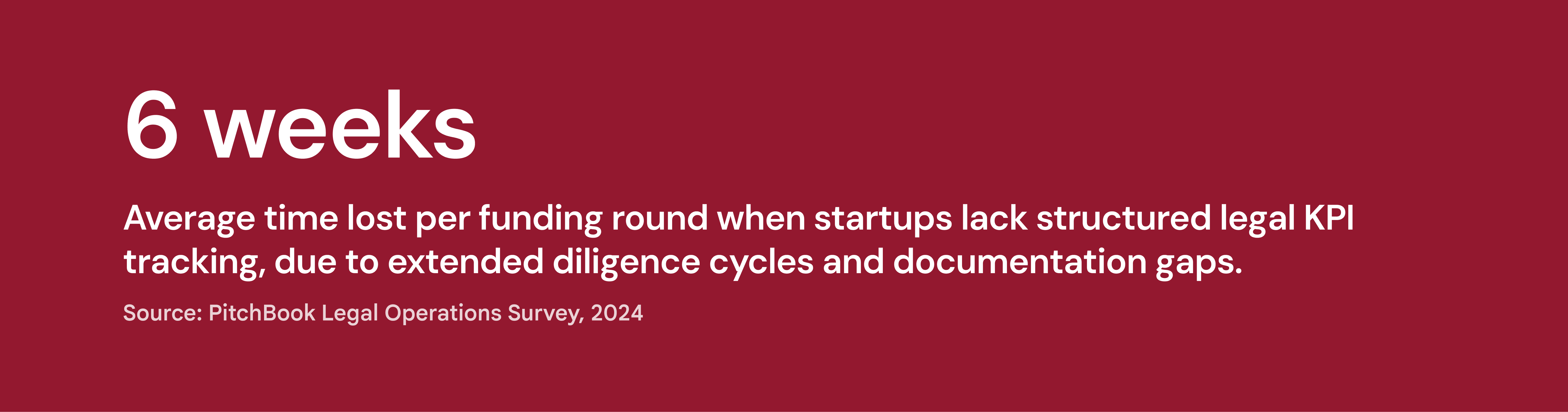
Diligence response time measures how long it takes to produce a complete response to a legal documentation request from an investor, enterprise buyer, or regulatory body. This is a direct measure of legal infrastructure maturity and one of the clearest indicators of how a fundraise process will go.
Building Visibility Without Adding Overhead
The standard objection to tracking legal KPIs is that it requires too much administrative effort. That is true when legal operations rely on manual processes and fragmented tools. When legal infrastructure is properly structured, the data surfaces automatically as a byproduct of how the work gets done rather than a separate reporting exercise.
Lexapar provides real-time visibility into contract cycle times, deviation rates, obligation completion, and approval workflows as part of the operational system. COOs get a clear picture of legal performance without requiring the legal team to produce manual summaries. The metrics become part of operational rhythm rather than a quarterly reconstruction.
Give your COO real visibility into legal performance
Lexapar surfaces legal KPIs continuously so operational risk is measured and managed, not guessed at.
