Legal Infrastructure Checklist Before Raising Series A
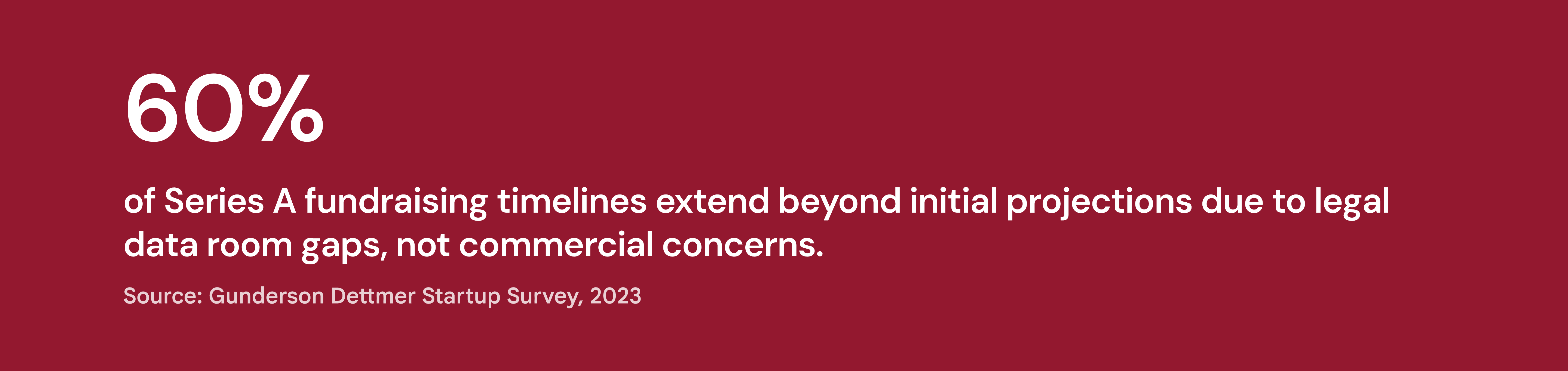
Most founders spend months preparing their pitch deck and financial model before a Series A. The legal data room typically gets two to three weeks of attention at the end, assembled under deadline pressure from a combination of shared drives, email chains, and institutional memory.
That sequencing is one of the most avoidable reasons fundraisers slow down or stall. Investors use legal diligence not to hunt for problems but to assess organizational maturity. A clean, well-organized legal record signals that the company has been making deliberate decisions as it has grown. A fragmented one signals the opposite, regardless of how strong the commercial numbers are.
This checklist covers the legal infrastructure that institutional investors at Series A expect to find. It is not a compliance checklist. It is an operational readiness assessment. The goal is not legal perfection. The goal is being able to explain every significant decision clearly, consistently, and quickly when the questions start arriving.
Corporate Structure and Cap Table
Your cap table needs to be clean, current, and reconcilable against your incorporation documents and every share issuance since formation. Investors will trace the full ownership history. Every SAFE, convertible note, and prior equity round needs complete documentation. Founder vesting schedules need to be documented and consistent with what the term sheet describes. Side letters need to be disclosed and organized.
Gaps in the cap table create some of the most time-consuming diligence conversations because they require reconstructing historical events that should have been documented at the time. The further back the gap, the longer the process takes and the more it erodes confidence in how the company has been governed overall.
Intellectual Property Ownership and Assignment
Every person who contributed materially to the core technology needs a signed IP assignment agreement on file. This includes co-founders, early contractors, advisors who contributed to product development, and anyone who worked before the formal company structure was in place.
IP ownership risk is one of the issues investors escalate fastest and hardest. A missing or unsigned assignment agreement creates a fundamental question about whether the company actually owns what it is selling. It is also one of the most straightforward issues to close before a process begins, which makes it particularly costly to leave unresolved until diligence starts.
Open source usage also needs to be documented, with license types reviewed for restrictions on commercial use. This is consistently underestimated by technical founders and consistently scrutinized by investor counsel.
Regulatory Positions and Compliance Reasoning
For fintech and healthtech companies in particular, documented regulatory reasoning is not optional. Investors want to see that each material regulatory interpretation has a recorded rationale, a defined owner, and a date of last review.
They are not looking for certainty on every question. Regulatory ambiguity is understood and expected in growth-stage companies operating in evolving frameworks. What they are looking for is evidence that the questions were asked deliberately, that someone owned the answer, and that the position has been applied consistently.
Undocumented regulatory assumptions are one of the leading causes of diligence expansion in regulated sectors. When a company cannot explain why it operates the way it does from a compliance standpoint, the response is not to accept the answer. It is to ask more questions across every adjacent area until confidence is established or the process collapses.

Key Commercial Agreements
Enterprise agreements, data processing agreements, partnership contracts, and any revenue-generating arrangement need to be organized, indexed, and searchable. Investors will look specifically for concentration risk, unusual liability positions, indemnity exposure that is not aligned with insurance coverage, and assignment or change of control clauses that could complicate the transaction itself.
The legal layer (sub-processor obligations, breach notification alignment, data exit provisions, security standard specificity) gets far less attention until something forces it. In a Series A process, that something is investor counsel reviewing your agreements in detail. Identifying and addressing these gaps before the process starts is materially less disruptive than managing them under diligence pressure.
Employment and Equity Documentation
Offer letters, NDAs, IP assignments, and equity grant documentation for key employees and contractors need to be complete and filed. Any informal compensation commitments, side arrangements, or equity promises that were not formally documented are a diligence risk. Not because they are necessarily problematic but because anything that requires reconstruction creates doubt about what else may have been handled informally.
This is also the point at which investors will check for outstanding equity disputes, cliff or vesting inconsistencies, and arrangements made with early team members that were verbal rather than written. The earlier these are addressed, the less disruptive the conversation.
The Real Differentiator
Most companies can produce the documents eventually. The differentiator in diligence is whether those documents tell a coherent story about how the company has governed itself over time.
Investors test this deliberately. The same regulatory question gets asked in three different formats across documents, interviews, and management presentations. When the answers are consistent, diligence moves. When they are not, the process expands and the confidence it was supposed to build erodes instead.
Companies that move through Series A diligence efficiently share one characteristic. They did not prepare for diligence when the process started. They built the habits and systems that make diligence straightforward as part of how they operate day to day.
Lexapar is built for exactly that layer. Legal decisions are centralized at the point they are made. The reasoning behind approvals and exceptions is preserved. Regulatory positions are documented with context and ownership. Contract deviations are logged with rationale. When the investor process begins, the data room reflects an organization that has been governing itself consistently, not one that has retrospectively assembled evidence of doing so.
Prepare your legal infrastructure before the raise begins
Lexapar centralizes legal decisions, preserves reasoning, and keeps your documentation investor-ready continuously, not just at fundraise time.
