How SaaS Teams Can Stop Drowning in Contracts
SaaS companies rarely lose deals because they signed too many contracts. They lose leverage because risk was not architected at the enterprise level before concessions were made.
In regulated healthtech and fintech, contract volume is not the problem. Fragmentation is. Over time, commercial urgency drives small concessions across MSAs, side letters, security addenda, data processing agreements, and customer specific SLAs. Each looks immaterial in isolation. In aggregate, they reshape risk allocation in ways no one has mapped back to operational capability.
By the time a company prepares for a growth round, acquisition, or regulatory review, the issue is no longer drafting quality. It is structural coherence.The issue is not concession itself. It is unmanaged cumulative deviation from baseline risk assumptions.
In diligence environments, revenue strength does not offset incoherent risk allocation. Valuation compression follows when contractual exposure is misaligned with internal controls. The documents may be executed. The allocation logic is not systematized.
The Hidden Structural Risk
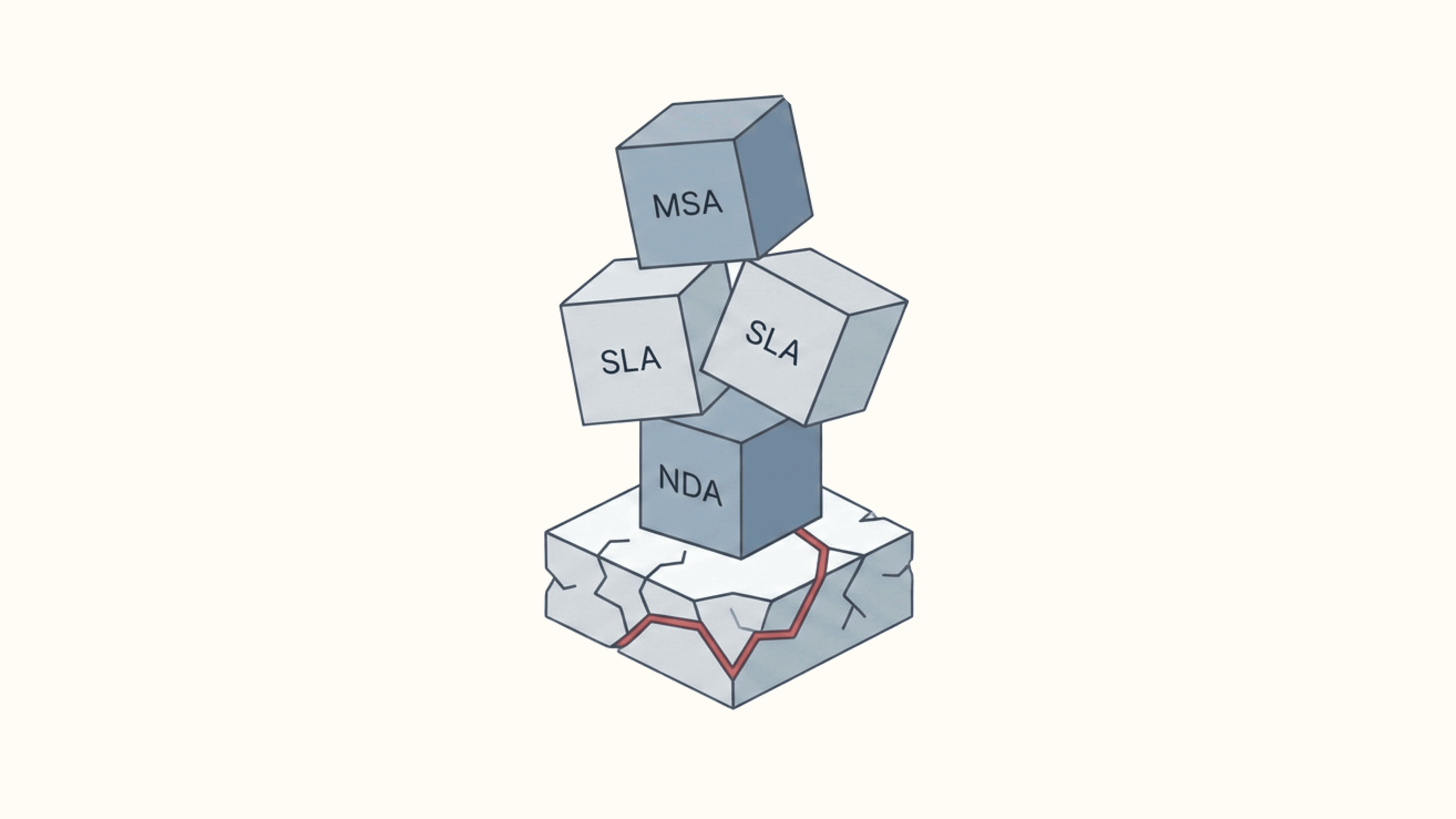
Most SaaS teams treat MSAs, SLAs, and NDAs as separate instruments.
They are not.
Together, they define the enforceable perimeter of operational risk:
• How liability is allocated
• What performance standards are contractually binding
• How confidentiality and data handling obligations extend beyond product architecture
• Which indemnities can be triggered by operational drift
The risk is rarely in a single clause. It sits in cross document interaction.
An MSA may cap liability at twelve months of fees. An SLA may include service credits that function economically as uncapped exposure. A data protection addendum may introduce indemnities tied to regulatory fines. A customer specific security exhibit may incorporate standards the company does not operationalize consistently across its environment.
Individually defensible. Collectively unstable. No board models exposure at clause level. Risk is assessed at portfolio level.
When investors or buyers review the contract stack, they are not reading for legal elegance. They are testing whether revenue quality aligns with controllable risk. If indemnity exposure exceeds insurance coverage, if SLA metrics are inconsistent with infrastructure realities, or if confidentiality obligations extend to third party tools not properly audited, the conversation shifts quickly from growth to contingency.
That shift shows up in escrow demands, purchase price adjustments, or expanded representations and warranties.
At scale, contract negotiation is delegated. Sales negotiates service levels. Security responds to vendor questionnaires. Legal revises templates under time pressure. Founders approve commercial exceptions to close strategic accounts.
Without centralized exposure mapping, deviation compounds without visibility across the enterprise.
In regulated sectors, this drift is amplified.
In healthtech, data handling commitments often exceed statutory minimums. In fintech, uptime representations may conflict with third party dependency risk. When regulators inquire or when an acquirer requests incident history, teams discover that contractual commitments outpace documented controls.
The issue is not non compliance. It is structural asymmetry between contractual commitment and operational capability.
That asymmetry creates three material consequences.
First, valuation pressure. Buyers discount when they cannot model downside cleanly. Unquantified indemnity tails or inconsistent limitation of liability language reduce predictability. Predictability underwrites valuation multiples.
Second, escrow expansion. Where exposure cannot be ring fenced confidently, holdbacks grow.
Third, diligence friction. Time is consumed reconciling why specific enterprise customers have materially different risk profiles embedded in side letters or bespoke SLAs.
None of these outcomes are driven by malicious drafting. They arise from decentralized reasoning.
NDAs: The Overlooked Exposure Vector
NDAs are often treated as low risk, high volume documents.
In regulated SaaS, that assumption fails.
Confidentiality definitions frequently expand to include customer data samples, audit findings, and derivative analyses. Residuals clauses are negotiated inconsistently. Data retention provisions may conflict with internal deletion practices. Assignment clauses may restrict transfer in a change of control scenario, creating friction in M and A execution.
During diligence, buyers do not only review customer MSAs. They review inbound and outbound NDAs to assess whether intellectual property and data rights are cleanly assignable.
Legacy NDA inconsistency complicates change of control mechanics and intellectual property assignability.
SLAs as Economic Instruments
Service levels are rarely priced accurately for risk.
If uptime credits accumulate without aggregate caps aligned to liability limitations, the economic exposure can exceed what finance has modeled. If termination rights are triggered by recurring performance failures without a structured cure framework, revenue predictability becomes fragile.
More critically, if SLA commitments are not mapped to actual monitoring systems and documented incident response protocols, defensibility weakens during dispute or regulatory review.
In diligence, sophisticated counterparties ask one simple question: can you prove compliance with your own commitments?
If reporting is inconsistent or historical performance data is not centralized, legal assurance becomes aspirational rather than evidentiary.
The Operational Gap
Founders and CFOs often believe the contract stack is a legal inventory issue. It is not.
It is a systems issue.
The absence of structured mapping between:
• Contractual risk allocation
• Insurance coverage
• Technical controls
• Incident response processes
• Regulatory obligations
When these layers are not reconciled, exposure cannot be quantified with precision. It creates a silent exposure layer.
This is where deals stall. Not because contracts are missing, but because reasoning is undocumented and exposure cannot be traced.
Moving From Documents to Infrastructure
The companies that navigate scale cleanly do one thing differently. They treat contracts as operational inputs, not static files.
Every negotiated deviation is logged against a risk taxonomy. Indemnities are categorized by trigger type and financial scope. Service levels are reconciled with monitoring outputs. Data obligations are mapped to specific systems and subprocessors.
When diligence begins, they are not reconstructing logic. They are demonstrating it.
This is not about automating drafting. It is about systematizing allocation.
The solution is not additional drafting capacity. It is structured risk intelligence. Lexapar operates at that layer.
Instead of serving as another repository, it captures the reasoning behind contractual positions, maps deviations across the portfolio, and links allocation to operational reality. A newly negotiated SLA is evaluated against existing commitments, insurance thresholds, and regulatory posture. Atypical assignment language in an NDA is flagged for downstream change of control implications before a transaction surfaces.
The result is not cleaner documents. It is defensible coherence.
In regulated SaaS, defensibility is currency. Investors price predictability. Regulators evaluate consistency. Acquirers scrutinize exposure tails.
Drowning in contracts is rarely about volume. It is about the absence of structured alignment between what is promised and what can be proven.
Companies that address this early convert legal from a reactive function into risk infrastructure. When scrutiny arrives, whether from regulators, auditors, or buyers, the conversation shifts from explanation to evidence.
In institutional markets, coherence is leverage.
Turn Contract Drift Into Risk Intelligence
Track deviations, quantify exposure, and align commitments with controls.
