AI Contract Review Software: A Practical Buyer's Guide for Indian Startups
The market for AI contract review tools has expanded significantly in 2025 and 2026. For Indian startups evaluating options, the volume of available tools has made the buying decision harder rather than easier. Most tools make similar claims about speed, accuracy, and risk detection. The differences that actually matter for a scaling startup are rarely the ones in the marketing material.

This guide covers the evaluation framework that matters for Indian startups specifically: the questions to ask, the capabilities to test, and the red flags that distinguish genuine legal infrastructure from a contract summary tool with a more expensive pricing page.
The First Question: What Problem Are You Actually Trying to Solve?
Most AI contract review tools are optimized for one of two things: speed of first-pass review, or identification of non-standard clauses. Both are useful. Neither is sufficient for a scaling startup that needs legal operations to support commercial velocity, diligence readiness, and regulatory compliance simultaneously.
Before evaluating any tool, the buying team should be able to articulate whether the primary problem is review speed, risk identification, position consistency, obligation tracking, or audit readiness. Different tools solve different problems and a tool optimized for speed in a law firm context is not the same as infrastructure designed for startup legal operations.
Capabilities That Actually Matter for Startups
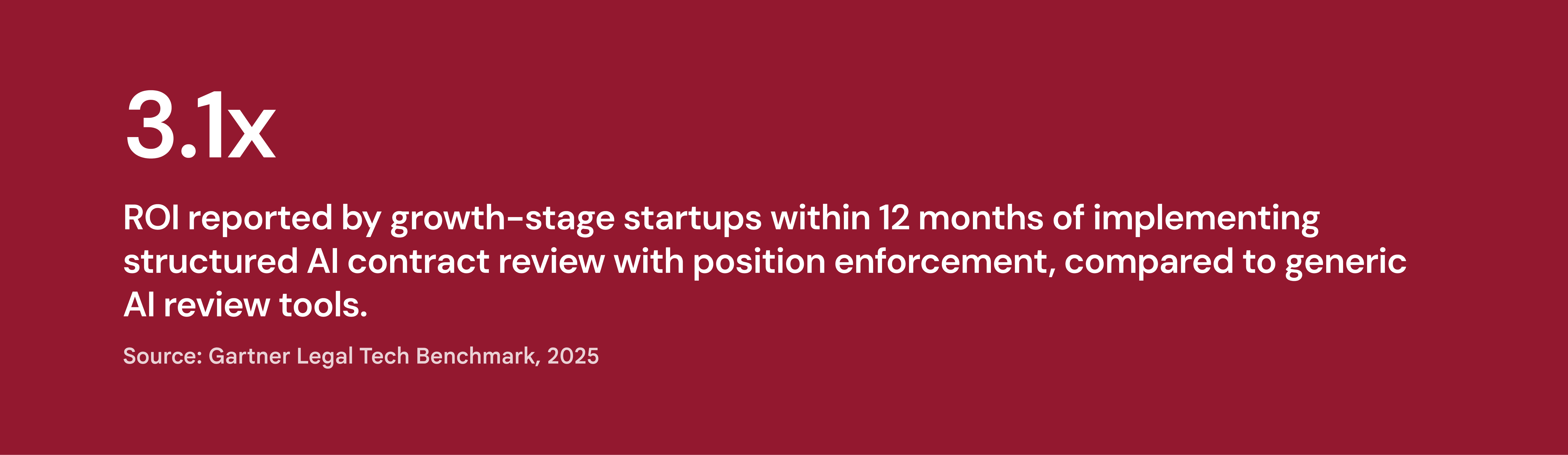
Position enforcement is the first differentiator. Can the tool assess contracts against documented company positions rather than generic legal standards? Generic risk flagging tells you that a liability cap is low. Position enforcement tells you that it is below your defined acceptable threshold and routes it to the right approver. The second is far more useful for operational legal management.
Deviation tracking and portfolio visibility matter more than most buyers realize at the point of purchase. A tool that reviews contracts in isolation and does not connect that review to the existing portfolio is a faster version of the current workflow, not a different one. Portfolio visibility is what prevents contract drift and what makes diligence preparation manageable.
Audit trail and rationale capture is non-negotiable for any company that will face investor or regulatory scrutiny. When a deviation is approved, the tool should record why, by whom, and against what risk assessment. That record is what makes the approval defensible later.
Red Flags in the Evaluation Process
A tool that cannot demonstrate how it handles deviations from your specific positions, not a generic legal standard, is not infrastructure. It is a faster document reader. A tool with no portfolio-level view across executed agreements cannot address contract drift. A tool with no audit trail capability cannot support diligence.
Also worth testing: how the tool handles ambiguous clauses where the right answer depends on commercial context rather than legal standard. Generic AI tools produce generic answers to these questions. Tools built for startup legal operations should surface the ambiguity and route it to a human with the relevant context attached.
Lexapar is not a contract summary tool or a generic AI reviewer. It is legal operating infrastructure for scaling startups. Position enforcement, deviation tracking, portfolio visibility, and audit trail capture are core to how it works, not features bolted onto a review engine. For Indian startups evaluating AI contract review in 2026, that distinction is the one that matters most.
Evaluate Lexapar against your specific legal operations needs
See how position enforcement, deviation tracking, and portfolio visibility work in practice for a scaling startup.
