Agentic AI for Contracts: What It Means for Startup Legal Teams in 2026
For the past two years, AI in legal has largely meant AI-assisted review: a tool that reads a contract and flags clauses for a human to evaluate. That model is useful and it is already being absorbed into standard legal workflows. But it is not where the industry is heading.

Agentic AI represents a different category. Instead of flagging issues for human review, agentic systems can take sequences of actions, make decisions within defined parameters, and complete multi-step tasks with minimal human intervention at each step. In the context of contract operations, that shift has significant implications for how legal teams scale and how much of the routine workflow actually requires human judgment.
What Agentic AI Actually Does in a Contract Context
The distinction between AI-assisted and agentic AI is not about speed. It is about the scope of autonomous action. An AI-assisted tool identifies that a liability cap is non-standard and surfaces it for review. An agentic system can identify the non-standard cap, compare it against the company's approved deviation history, assess whether it falls within pre-authorized parameters, route it to the correct approval level if it does not, and draft the counter-proposal, all without human initiation at each step.
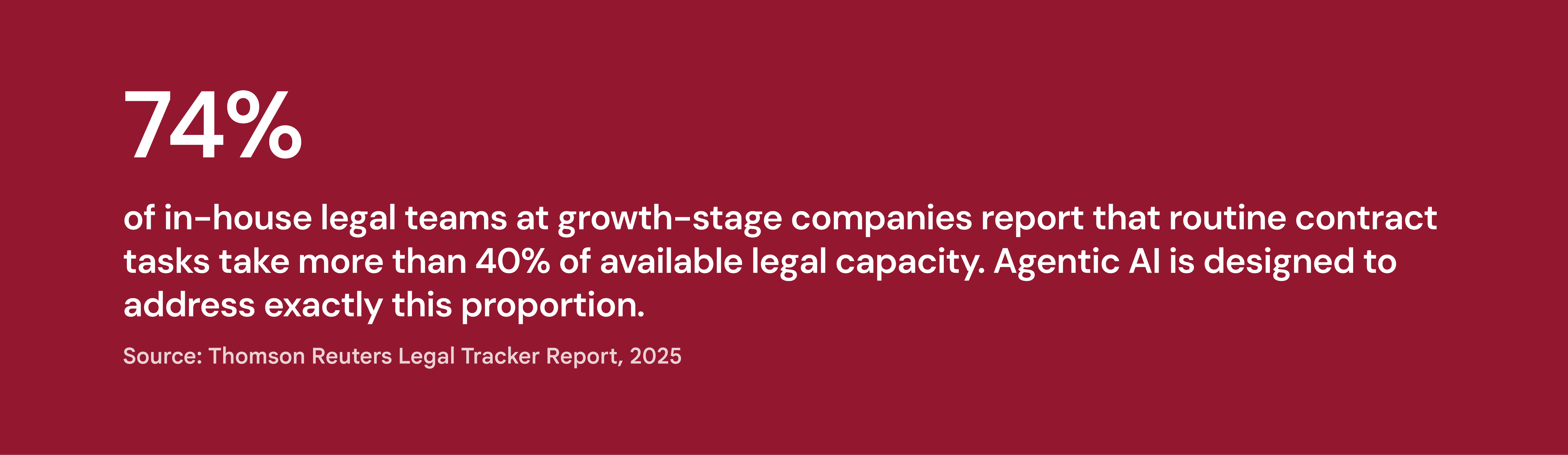
This matters for startup legal teams because it changes the ratio of human judgment required per contract. Not eliminating it, but concentrating it on the decisions that genuinely need it rather than distributing it evenly across all decisions regardless of complexity.
The Risk That Comes With Agentic Systems
The risk of agentic AI is not that it will make wrong decisions. It is that wrong decisions will be made at scale and at speed before anyone realizes they are wrong. An AI-assisted tool that misidentifies a clause creates one bad review. An agentic system operating on the same misidentification across a hundred contracts creates a portfolio problem.
This makes the quality of the underlying legal framework, the documented positions, the approved deviation parameters, and the defined escalation thresholds more important than it has ever been. Agentic AI amplifies whatever framework it operates within. If that framework is well-defined and current, the amplification is positive. If it is informal or out of date, the amplification is risky.
What This Means for How Legal Infrastructure Needs to Be Built
For startup legal teams, the practical implication is that the work of documenting and maintaining legal positions becomes more valuable, not less, as agentic AI becomes more capable. The framework is what the AI operates against. Teams that invest in that framework now are building the foundation that makes agentic tools safe and effective to deploy.
Lexapar is built on this principle. Legal positions are documented and maintained inside the platform. Approval parameters are defined and enforced. Deviation history is preserved with rationale. When agentic capabilities are layered onto that foundation, they amplify institutional legal discipline rather than improvised judgment.
Build the legal framework that makes AI work safely
Lexapar gives your legal team the documented positions, deviation parameters, and approval infrastructure that agentic AI requires to operate correctly
